


When selecting a diamond, two factors must be considered! First, there is the stone shape and second, the stone quality: Initially, you should think about what shape the diamond should be cut into for your engagement ring. There are countless cut shapes, such as Brilliant (round) or Princess Cut (square), which we will discuss in more detail below. The actual diamond quality is determined by four quality criteria, the so-called 4C's (Carat, Color, Clarity, Cut).
The 4 C's
Carat (weight), Color (color), Clarity (purity) and Cut (cut quality). All these properties determine the value of a diamond. A large diamond in poor quality can be worth less than a small, yet flawless diamond. Therefore, it is important to ensure that the diamond is of good to very good quality.

What to look for when buying a diamond!
Only flawless diamonds (IF) are absolutely perfect. However, even for experts, it is not easy to detect small impurities with the naked eye, as long as they are at most very small (SI1). Only visible inclusions (I1–I3) disturb the overall appearance and also reduce brilliance. The same applies to color: An absolutely colorless diamond (D) would of course be desirable, but is very expensive. Nearly colorless and more affordable diamonds are a very good alternative for most occasions (e.g., color G or better). Yellowish-tinted diamonds (such as K) are not recommended and are therefore not offered by BREEDIA.
1. Carat – Weight
Carat indicates the weight of the diamond, where 1 carat equals exactly 200 mg. At BREEDIA, you will find diamond jewelry from 0.05 to 1 ct. In rings with multiple stones, stones of 0.001 ct to a maximum of 0.05 ct are usually offered on the ring band. Through the weight of a brilliant, the size of the stone can be approximately determined, since the proportions are almost the same with the same cut.

2. Color – Color
Color indicates whether a diamond is colorless or has a yellow tint. Diamonds of the best quality are colorless or in a very fine white and are therefore also the most valuable. Color is one of the most important factors in determining quality.

In general, we recommend diamonds in color G (TW, Top Wesselton). Upon request – or if the configuration allows – a better quality can also be selected.
Since the designation of diamond color quality varies greatly internationally, you can see the most commonly used quality grades in the following table:

In Germany, German terms were previously used to grade diamonds. Today, however, designations according to English or American standards are more common. For diamonds under 0.30 ct, English additions are therefore often found, e.g., for fine white Top Wesselton (TW) is specified. Diamonds from 0.30 ct are supplied exclusively with GIA or IGI expertise at BREEDIA. Here, the evaluation is in alphabetical order from D to Z. Therefore, from these stone sizes onwards, you will only find the American designation in our certificates.
Not to be confused is the "color of a diamond" with "colored diamonds", the so-called Fancy Diamonds, including pink, yellow or black. These stones are evaluated according to their own standards. Fancy Diamonds are extremely rare and in most cases significantly more expensive than white diamonds (upon request, we also process colored untreated or colored treated diamonds).
Diamond Colors
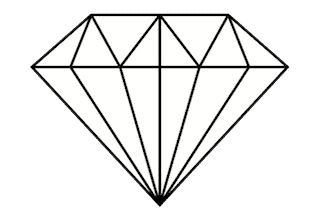
3. Cut – Cut Quality
The Cut is the most important criterion for the actual brilliance of a diamond and has become increasingly important in purchasing decisions in recent years. Cut is often confused with the term cut shape (i.e., round brilliant or square princess cut, etc.). However, cut in the sense of diamond grading actually refers to cut quality. Before a diamond is cut, it must first be determined how many diamonds can be cut from a single rough diamond. Typically, a rough diamond (due to its octahedral shape) is split into at least two stones to maximize the remaining weight afterwards. While this maximizes the yield for diamond cutters, it often results in poorly proportioned diamonds.
Only very well-cut diamonds, with the right ratio of height and width, reflect light back to the viewer and create that inner fire. Poorly cut stones scatter light in all directions and thus sparkle less. In addition to brilliance, the overall appearance of the facet arrangement is of great importance. When the facets on the top and bottom (viewed from above) are aligned with each other, a calm image is created for the viewer. If this is not the case, the stone appears very restless (this criterion is determined, for example, in GIA certificates by symmetry). Not quite as important, but still recognizable under magnification, is the quality of the polish. Ideally, no polish marks are visible. Poorly polished stones have recognizable white grinding marks under 10x magnification.
BREEDIA therefore offers exclusively diamonds with very good to excellent quality, because the diamond (even if flawless and colorless) simply would not look beautiful otherwise.

4. Clarity – Purity
Clarity defines the purity level of a diamond. Since diamonds are carbon compounds that form over millions of years under high pressure, other minerals can be trapped in the diamond during this process and disturb the crystal structure. Such inclusions and disturbances can limit brilliance. Absolutely flawless diamonds are therefore very rare and extremely valuable.

For jewelry purposes, diamonds with very small inclusions that are only visible under magnification are already suitable. We therefore offer diamonds with at least SI (small inclusions) or VVS/VS (depending on the collection) on almost all models, as these characteristics are not visible to the naked eye. Diamonds with the clarity grade I (Inclusions) are not offered, as inclusions are already visible to the naked eye at this level. As with the color of the 4C's, clarity is also evaluated according to international standards – as you can see from the following table:

The importance of independent certificates for diamond value:

In addition to the 4C's, expertise is also of great importance for the value of a diamond. Only diamonds certified by the Gemological Institute of America (GIA) or the International Gemological Institute (IGI) meet our high standards for diamonds from 0.3 ct. Grading by other institutes (however reputable they may sound) is less strict and therefore has a negative impact on price. For diamonds of at least 0.3 ct (for the main stone), GIA or IGI certificates are included in our delivery – diamonds under 0.3 ct are subject to our own strict evaluation.


