


« Tradition Between Golden Glamour and Celebration »
Welcome to the Orient! A Turkish wedding is glittering, loud, and traditional. Wedding customs are as much a part of it as meticulous preparation and many guests. From the engagement to the wedding celebration, not only the couple is in the spotlight, but family also plays a very significant role. Whether in Turkey or in Germany: When a Turkish wedding is celebrated, it's about both tradition and the joy of celebrating in a large circle of family and friends.
The Turkish Engagement – Family is Everything
In Turkish culture, parents often see the marriage of their children as a life mission and are therefore all the more delighted when their own child gets engaged. Their greatest wish is for their children to be well cared for in marriage. A romantic marriage proposal just for two is certainly no problem today – but afterwards, the intimate togetherness usually ends for the future couple. It's time for "Kız isteme": The groom visits the parents of his beloved with his own parents. His father then asks the bride's father for his daughter's hand on behalf of his son.
This Turkish wedding custom is not skipped even if the actual engagement has already taken place. The presence of other relatives is not uncommon. Immediately afterwards, there is a small celebration ("Söz kesme"), during which the engagement rings connected with a red ribbon are exchanged. This ribbon is cut by the head of the family only after the rings are put on – from this moment on, the engagement or promise is official. A large engagement celebration ("Nişan") is also a must. Many guests, food, music, and dancing characterize this evening. The bride usually wears a very pompous dress in a striking color – it should not be white or black.

(Almost) Only for the Bride – the Turkish Henna Night and "Kına gecesi"
It is tradition that the bride symbolically says goodbye to her family. A celebration takes place in her parents' home, attended by female relatives and girlfriends. They eat together, dance to music, and sing. The bride often wears traditional clothing with embroidered plant branches. There is also a red headscarf that is meant to hide the tears the bride sheds as she leaves her parents' home. According to tradition, sentimental songs are sung until the bride begins to cry – but often these are tears of joy in anticipation of the upcoming wedding.
Late in the evening, the groom also joins the gathering. In the middle of the room, now lit only by candlelight, the couple takes their place. The groom's mother places a coin in the hand of her future daughter-in-law so that she can open her palms for painting. Then henna, brought into the room on a silver tray, is applied to the bride's palms – usually by an older family member. As beautiful as the delicate patterns are: After two hours, everything is washed off again. The henna painting is meant to bring the couple good luck. A Turkish wedding without a henna night would be incomplete – it's simply part of the tradition.


Engagement Rings in All Colors
The Wedding Day – Tradition is Everything
For Muslim families, the declaration of marriage in the presence of an imam in a mosque is of great symbolic significance. Therefore, an Islamic wedding ceremony takes place a few days or a few hours before the actual Turkish wedding celebration, although it has no official function. For this – at least in Germany – there must of course also be a civil ceremony.
When the big day finally arrives to exchange wedding rings, it becomes particularly stressful for the bride. Wedding customs dictate that she first goes to the hairdresser with her closest relatives and girlfriends, where she is styled from head to toe. Particular attention is paid to the bridal hairstyle. During the styling marathon, music plays – and some even dance to get in the mood for the wedding. Back home, the bride gets dressed and spends some time at her parents' house. Meanwhile, preparations for "Gelin alma", the groom's pickup of the bride, are already underway outside the front door. Musicians drum, people dance and laugh – finally, the couple is accompanied to the car and driven to the wedding celebration venue.

The Turkish Celebration – Dancing at the Big Party
Although the couple is already married civilly and has also declared their marriage before the imam, tradition dictates that an altar is set up in the banquet hall where another wedding ceremony takes place. The louder the "yes", the greater the couple's love for each other is supposed to be. Of course, a kiss cannot be missing at the wedding. It is also a wedding custom that the newly married couple step on each other's foot. Whoever is faster is said to have the say in the marriage.
Now that the marriage is sealed here as well, "Düğün", the actual Turkish wedding celebration, begins. The celebration transforms into a big, lavish party: People dance and sing with all their might. The music is usually Turkish – folk music and pop play equally.

Money, Gold, and Bridal Shoes
Gifts play a major role when a Turkish wedding takes place. In Turkey, people want to help young newlyweds financially with gifts to start their married life – so money is often given. But it is also one of many wedding customs to give the couple gold: During the gold-hanging ceremony, guests adorn the couple standing in the middle of the room with gold in the form of jewelry (or money). If things are done very traditionally, the amount given is even announced so everyone can hear it. Sometimes guests, who line up in front of the couple, want to outdo each other with their gifts: They want to show what they give – and here too, family comes first, which is often reflected in the amount of money given.
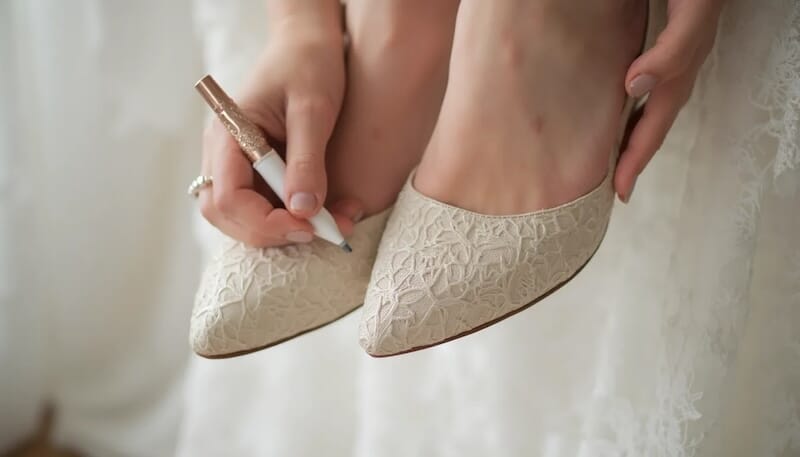
Before the bride takes to the dance floor, she writes the names of her unmarried girlfriends on the soles of her shoes. Whoever's name is no longer visible at the end of the wedding is probably the next bride – at least that's what tradition says.
Joie de Vivre and Tradition
Anyone who gets to experience a Turkish wedding experiences not only a huge party with food, music, and dancing, but also learns about many wedding customs. The henna night, the ceremonial pickup of the bride, and the traditional presentation of gifts are just a few of them. Hospitality is paramount – you are warmly welcome with family and friends!


